Introduction
Liposuction consistently ranks among the most popular cosmetic procedures in India delivering targeted, lasting contouring results that diet and exercise alone often cannot achieve. But what many patients do not fully anticipate is the recovery journey that follows.
Understanding the timeline before your procedure makes a real difference. It reduces anxiety when normal symptoms appear, helps you plan work and personal commitments, and ensures you do not inadvertently compromise your results.
This guide walks you through recovery week by week what to expect, what is normal, what is not, and what you should and should not be doing at each stage. Written with Jaipur's climate in mind, where heat and humidity add considerations generic recovery guides often miss.
What Happens to Your Body During Liposuction Recovery?
Before the week-by-week breakdown, it helps to understand what your body is doing during recovery.
When fat cells are removed, surrounding tissue blood vessels, connective tissue, nerves, and skin experiences significant disruption. The body responds with inflammation: fluid rushes into the treated area, causing the swelling that makes the post-operative period look and feel very different from the final result.
Over weeks and months, this response resolves. Fluid is reabsorbed, skin contracts to new contours, sensation returns, and bruising fades. The final shape progressively emerges.
The process is not linear most patients have good days and harder days, particularly in the first month. Understanding this prevents the most common mistake: judging the result too early.
Week 1: The Most Intense Phase
What to expect: The most uncomfortable week and also the most critical. Treated areas will be significantly swollen, bruised, and tender. In Jaipur's warm climate, swelling tends to be more pronounced than in cooler environments. A compression garment is fitted immediately and must be worn continuously.
Normal symptoms:
- Significant swelling the treated area may look larger than before surgery
- Bruising shifting from red to purple to yellow-green over the week
- Soreness, tightness, and tenderness in treated areas
- Mild to moderate pain managed with prescribed medication
- Temporary numbness or altered sensation in the skin
- Fatigue the body is using significant energy for internal repair
Do: Rest completely. Wear compression garment at all times except showering. Drink 2.5–3 litres of water daily. Take all medications on schedule. Attend your Day 2–3 post-operative check.
Don't: Remove the garment without guidance. Drive. Exercise. Expose treated areas to sunlight.
Call your surgeon immediately if: Fever above 38°C, increasing (not improving) pain, unusual discharge, or sudden worsening of swelling on one side.
Week 2: Stabilisation Begins
What to expect: The initial intensity begins to ease. Bruising fades. Swelling remains significant but is no longer worsening. Many Jaipur patients describe week two as the point where they begin to feel "like a person again."
Normal symptoms:
- Bruising fading to yellow-green; beginning to clear
- Swelling plateauing not dramatically reducing yet, but stable
- Tenderness easing from acute to a dull ache
- Itching under the garment a positive sign of healing
- Firmness developing under the skin
Do: Continue garment wear. Begin gentle 10–15 minute indoor walks if surgeon approves. Continue high fluid intake. Ask about lymphatic drainage massage when timed appropriately, it can significantly reduce swelling. Return to light desk work if approved.
Don't: Exercise or raise your heart rate significantly. Consume excessive salt. Expose treated skin to direct sun without protection.
Week 3 to 4: Early Improvement Visible
What to expect: Patients describe this as "frustrating but hopeful." Most bruising has cleared. Swelling is visibly reducing and glimpses of the new contour begin to appear particularly after overnight garment wear. In Jaipur's warmer months, heat can keep swelling slightly more persistent.
Normal symptoms:
- Most bruising resolved
- Swelling reduced but still present notably in late afternoon and evening
- Lumpy, uneven skin texture underneath almost universally present and self-resolving
- Numbness in areas; sensation returns gradually
- Increased energy; patients feel significantly better
Do: Continue garment wear many surgeons transition to daytime-only at this stage. Begin light exercise (gentle yoga, slow walking) if surgeon approves. Continue lymphatic massage if recommended. Begin SPF 50+ sunscreen on any treated skin exposed outdoors.
Don't: Aggressive exercise, heavy lifting, or high-impact activity. Swimming in pools or open water.
Week 5 to 6: Returning to Normal Life
What to expect: Most patients feel close to normal. Energy has returned, pain is largely resolved, and the new body shape is increasingly visible. The compression garment typically transitions to night-time only or a set number of daily hours.
Normal symptoms:
- Residual swelling still present, particularly in the lower abdomen and flanks
- Skin texture improving; lumpy areas smoothing
- Numbness largely resolved; mild tightness with certain movements
- Incision site scars fading from red/pink to lighter tones
Do: Resume exercise gradually moderate cardio first, building over two to three weeks. Continue SPF on treated skin. Attend your six-week review. Begin scar care silicone gel or sheets on incision sites.
Don't: Jump straight to high-intensity training, heavy lifting, or contact sport. Neglect sun protection scars darken with UV exposure.
Month 2 to 3: The Shaping Phase
What to expect: The result is increasingly visible and patients are generally very pleased. Most swelling has resolved, skin is contracting to the new contours, and body confidence is meaningfully improved. Morning swelling is minimal; evening swelling after a day on your feet is still common and expected.
Focus on: Maintaining results through stable diet and exercise. Continuing SPF on treated skin. Attending your three-month review. Ongoing scar care.
Month 4 to 6: Results Emerge Fully
What to expect: The transformation is substantially complete. Skin has contracted, residual swelling is minimal, and the contour is clearly visible. Patients who maintained stable weight and followed aftercare consistently typically report excellent satisfaction.
For Jaipur patients who had summer or monsoon surgery, the cooler October weather often coincides with this phase and the reduction in ambient heat typically helps skin firm up more visibly.
The Final Result: 6 to 12 Months
The absolute final result with all swelling resolved and skin fully contracted is typically seen at six to twelve months. For larger procedures or patients with slower skin contraction, twelve months is not uncommon.
Patients are often surprised to notice continued improvement between months six and twelve. This is entirely normal and a reason to avoid making final judgements before the six-month mark.
Cost of Liposuction in India
In Jaipur, liposuction typically ranges from ₹60,000 to ₹2,00,000 depending on areas treated, technique, and surgeon experience. Multiple areas treated together are priced more efficiently than separate sessions.
Additional recovery costs: compression garment if not provided (₹800–₹2,500), scar care products (₹500–₹2,000), and SPF sunscreen (₹400–₹1,500). Modest relative to the procedure investment.
Who Is a Good Candidate?
Recovery is most straightforward for patients who are at or near their stable, healthy weight, in good general health, able to take adequate time off work in the first two weeks, and committed to compression garment wear and activity restrictions.
Recovery is more challenging for patients who are significantly overweight, have diabetes or circulatory conditions, or cannot commit to the aftercare requirements.
Expert Tips for Faster Recovery
Wear the compression garment exactly as instructed from day one. It is not optional it shapes the result, reduces swelling, and prevents complications. Patients who wear it consistently achieve measurably better outcomes.
Hydrate aggressively. In Jaipur's climate, 3 litres of water daily during the first month is the minimum. Dehydration prolongs swelling and impairs repair.
Prepare your recovery space before surgery. Stock medications, dressings, the garment, a pillow arrangement, and easy nutritious food in advance. Post-surgery is not the time for errands.
Do not judge the result before month three. Evaluating during peak swelling is the most common source of patient anxiety — and almost always misleading.
Choose cooler months where possible. October to February offers the best recovery environment in Jaipur. If summer or monsoon surgery is necessary, plan your cooling and hydration strategy in advance.
Frequently Asked Questions
How long does swelling last?
Significant swelling resolves within three to four weeks. Residual swelling continues reducing over three to six months. Full resolution occurs between six and twelve months.
When can I return to work?
Desk work within one to two weeks for most patients. Physical or manual work typically requires four to six weeks off.
When can I exercise?
Light indoor walking from week two. Gentle yoga and slow walking from weeks three to four with surgeon's approval. Full exercise from week six, introduced gradually. High-intensity training from week eight to ten.
Will the fat come back?
The removed fat cells do not return. Remaining fat cells can expand with significant weight gain — patients who maintain a stable weight preserve results long-term.
Is recovery painful?
Week one involves meaningful soreness, tightness, and bruising — managed with prescribed medication. By week two, most patients rate discomfort as mild. Uncomfortable rather than severely painful for the majority.
Conclusion
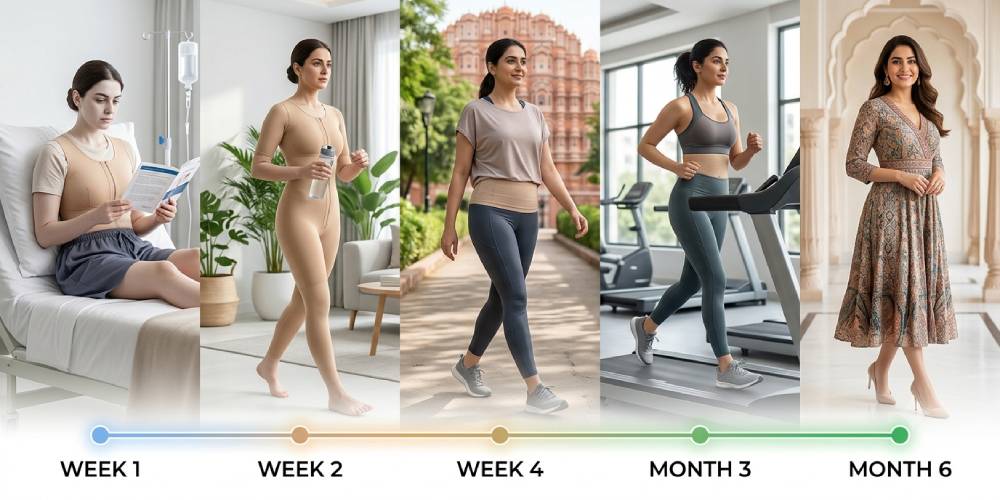
Liposuction recovery is a journey, not a single event. Week one is the most demanding; week two brings significant relief; month three reveals the emerging result; and six to twelve months brings the full transformation.
Patients who understand this timeline, follow their aftercare, and give their body the time it needs consistently achieve the best outcomes. The compression garment, the hydration, the sun protection, and the patience are not optional. They are the foundation on which your result is built.
At our clinic in Jaipur, every liposuction patient receives a detailed week-by-week recovery plan. Our team is here at every stage.