Introduction
If you have been researching hair transplants, you have almost certainly come across two terms: FUE and FUT. They are the two most widely performed techniques in the world and choosing between them is one of the most important decisions you will make.
Here is the truth most clinics do not state clearly: neither technique is universally better. Each has real advantages, real limitations, and specific patient profiles for which it is the more appropriate choice. The right one depends on your degree of hair loss, donor density, lifestyle, budget, and goals.
This blog breaks down both techniques honestly so you can make an informed decision.
What Is FUE (Follicular Unit Extraction)?
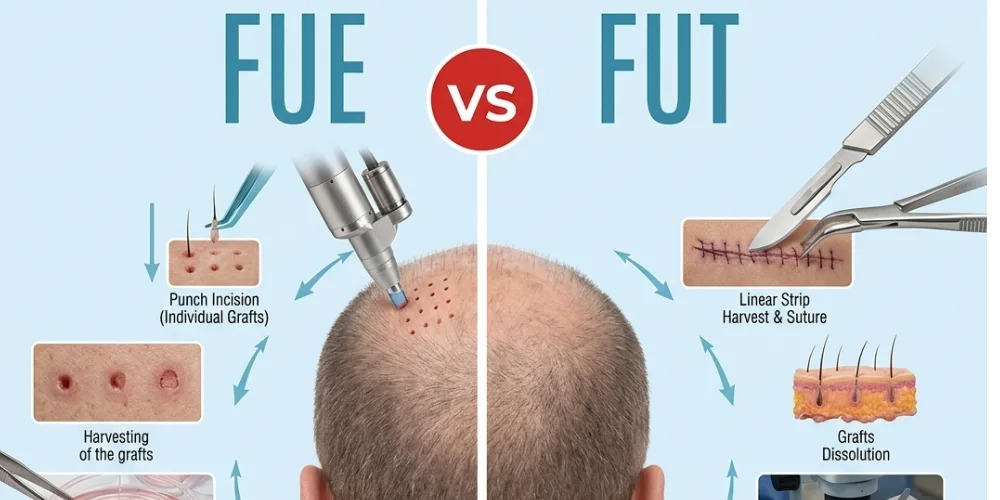
FUE extracts individual hair follicles from the donor area typically the back and sides of the scalp using a small circular punch tool of 0.6 to 1.0 mm. Each follicular unit is then implanted into tiny incisions in the recipient area.
Because follicles are taken individually, FUE leaves only tiny, dot-like scars that are virtually invisible once healed even with very short hair. It is currently the most widely performed hair transplant technique globally and the preferred method at most modern clinics in India.
What Is FUT (Follicular Unit Transplantation)?
FUT — the strip method involves surgically removing a strip of scalp from the donor area, which is then dissected under a microscope into individual follicular units and implanted into the recipient area.
The donor site is sutured, leaving a single linear scar across the back of the head. This scar can be concealed with hair at a moderate length, but becomes visible with very short or shaved styles.
FUT allows more grafts to be harvested per session and is particularly valuable for patients with extensive hair loss who need maximum yield.
The Core Difference: Individual Extraction vs Strip Harvesting
The entire distinction between FUE and FUT lies in how donor hair is harvested.
FUE extracts follicles one by one meticulous and time-intensive, with no linear scar and minimal post-operative discomfort, but with a lower graft count per session.
FUT removes a strip of scalp and dissects it into individual grafts more efficient harvesting with higher graft yield, but leaving a permanent linear scar.
Everything else recipient site preparation, implantation, growth timeline, and final results is broadly the same. The difference is almost entirely in the harvesting method.
Benefits of Each Technique
Benefits of FUE:
- No linear scar tiny dot scars virtually undetectable even with very short hair
- Faster recovery; most patients return to normal activity within a week
- Can harvest grafts from beard, chest, or body as supplementary sources
- Less post-operative donor-area discomfort
Benefits of FUT:
- Higher graft yield typically 20 to 30 percent more grafts than FUE per session
- Often more cost-effective per graft
- Preserves scalp donor area for potential future FUE sessions
- Ideal for patients needing 3,000+ grafts in a single procedure
How Each Procedure Works: Step by Step
FUE:
- Consultation — Hair loss graded, donor density assessed, graft count estimated
- Shaving — Donor area trimmed to 1–2 mm
- Anaesthesia — Local anaesthesia to both areas
- Extraction — Individual follicles extracted one at a time; several hours for larger counts
- Implantation — Grafts placed into recipient sites
- Recovery — Donor heals in 7–10 days; growth from 3–4 months; full result at 12 months
FUT:
- Anaesthesia — Local anaesthesia to the donor strip area
- Strip removal — Scalp strip excised; size determined by graft count needed
- Dissection — Strip dissected under magnification into individual units
- Closure — Donor sutured; stitches removed at 10 to 14 days
- Implantation — Grafts placed into recipient area
- Recovery — Donor scar heals over several weeks; growth timeline same as FUE
Types and Variations
FUE Variations:
- Manual FUE — surgeon-controlled punch; greatest precision and lowest transection rates in skilled hands
- Motorised FUE — powered punch; faster but requires careful technique to avoid graft damage
- Robotic FUE (ARTAS) — AI-assisted extraction; high consistency; available at select premium clinics
- DHI — FUE variation using a Choi pen for direct implantation without pre-made incisions; precise angle and direction control
FUT Variations:
- Standard single-strip FUT — the most common approach
- Trichophytic closure — refined suture technique allowing hair to grow through the scar, significantly reducing visibility
Advantages and Disadvantages: Side by Side
FUE — Advantages:
- No linear scar; suitable for all hair lengths including very short styles
- Faster recovery; less donor-site discomfort; body hair as supplementary source
FUE — Disadvantages:
- Slower harvesting limits graft count per session
- Higher per-graft cost; multiple sessions may be needed for extensive loss
- Slightly higher transection risk with inexperienced surgeons or motorised tools
FUT — Advantages:
- Higher graft yield per session; more efficient for large-area coverage
- More cost-effective per graft; preserves scalp donor area for future FUE
FUT — Disadvantages:
- Permanent linear scar visible with very short or shaved hair
- Longer donor recovery; temporary tightness
- Suture removal required at 10 to 14 days
Cost Comparison in India
In India, there is a meaningful cost difference between the two techniques:
FUE: ₹30–₹80 per graft; a 2,000-graft session costs approximately ₹60,000–₹1,60,000. DHI: ₹50–₹120 per graft.
FUT: ₹20–₹60 per graft; a 2,000-graft session costs approximately ₹40,000–₹1,20,000.
For patients needing 3,000 or more grafts, FUT is significantly more cost-effective. For those with moderate loss who prioritise no visible scarring and faster recovery, FUE's premium is generally considered worthwhile.
Who Should Choose Which?
Choose FUE if:
- You wear your hair short and do not want a linear scar
- Your hair loss is mild to moderate and one session will suffice
- You want faster recovery and less donor-site discomfort
- You are open to body hair as a future supplementary source
Choose FUT if:
- You need 3,000 or more grafts in a single session
- You are comfortable with a linear scar concealed by surrounding hair
- Per-graft cost is a significant consideration
- Your surgeon recommends it based on your donor density and loss pattern
The combination approach: Some patients use FUT first for maximum graft yield, then FUE in subsequent sessions around the linear scar. This staged strategy is used by experienced surgeons to maximise lifetime donor usage.
Tips for Making the Right Decision
Let graft count guide the decision. Needing more than 3,000 grafts in one session makes FUT the more practical choice. For 1,500 to 2,500 grafts, FUE is the preference for most patients and surgeons today.
Be honest about your hairstyle. If you wear grade 1 or 2 hair or a shaved look, a FUT linear scar may be visible. At moderate lengths, it is easily concealed.
Ask about your surgeon's experience with both. A surgeon experienced in FUE and FUT can give a genuinely unbiased recommendation. Some clinics perform only FUE that limits your options.
Do not decide on cost alone. FUT is cheaper per graft, but the right technique for your goals is always the more cost-effective one. A second procedure because the first was insufficient is never the economical choice.
The technique is not the result. Naturalness, density, and hairline design are determined by surgical skill, graft handling, and aftercare not by which harvesting method was used.
Frequently Asked Questions
Which technique gives more natural results?
Both produce natural-looking outcomes in experienced hands.Hairline design, graft angle, and density not the harvesting method determine how natural the result looks.
Is FUE more painful than FUT?
Neither is painful during the procedure both use local anaesthesia. Post-operatively, FUT typically involves more donor-area discomfort due to the linear incision; FUE recovery is milder and faster.
Can a FUT scar be corrected
Yes. FUE can be used in subsequent sessions to implant grafts directly into a FUT scar, significantly reducing its visibility. This is a common and effective approach.
How do I decide which is right for me
A thorough in-person consultation including scalp assessment, donor density measurement, and Norwood grading is the only reliable way to determine which technique suits your situation.
Conclusion
FUE and FUT are both proven, effective techniques capable of producing natural, lasting results in skilled hands. FUE offers no linear scar, faster recovery, and flexibility for moderate hair loss. FUT delivers superior graft yield, lower per-graft cost, and is the technique of choice for extensive hair loss requiring maximum coverage in a single session.
The question is never which technique is better in the abstract it is which is better for you. That answer comes from an honest assessment of your hair loss, donor supply, lifestyle, and goals.
We would be glad to assess your specific situation and give you a clear, honest recommendation whichever technique that turns out to be.