Introduction
If you are dealing with hair loss and exploring your options, two treatments come up more than almost any other: hair transplant surgery and PRP (Platelet-Rich Plasma) therapy. Both produce real results but they work in fundamentally different ways, suit different patients, and deliver very different outcomes.
Choosing between them depends entirely on your individual situation: how much hair you have lost, the cause, your expectations, your budget, and how much time you can invest. This blog breaks down both treatments honestly so you can decide with clarity.
What Is a Hair Transplant?
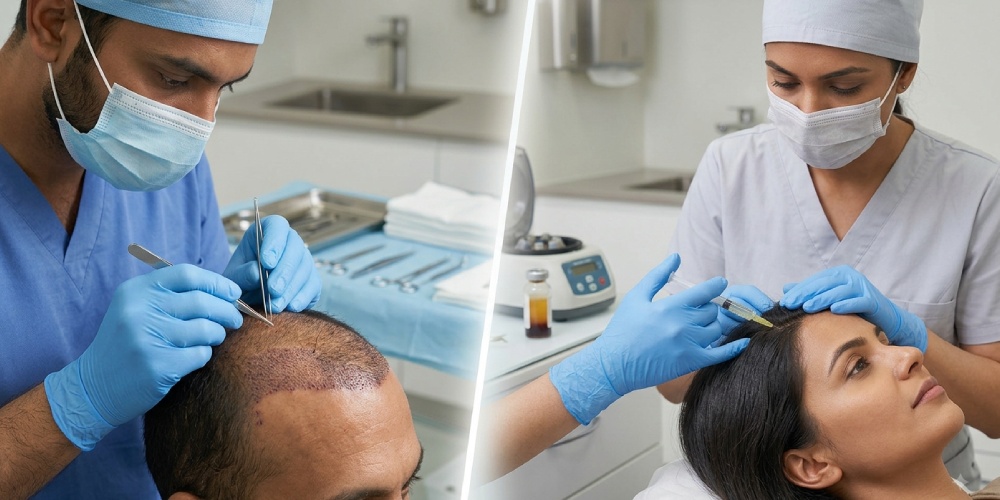
A hair transplant permanently relocates living hair follicles from a donor area typically the back and sides of the scalp, where hair is genetically resistant to balding to areas of thinning or complete hair loss.
The most common techniques are FUE (individual follicle extraction), FUT (strip removal and dissection), and DHI (direct implantation using a specialised pen). Transplanted hair grows naturally and permanently, retaining the DHT resistance it had in the donor area.
What Is PRP Therapy?
PRP (Platelet-Rich Plasma) therapy is a non-surgical treatment that uses the patient's own blood to stimulate hair growth. A small blood sample is drawn, spun in a centrifuge to concentrate growth factors, and injected into thinning areas of the scalp.
These growth factors including PDGF, VEGF, and EGF stimulate dormant follicles, improve scalp blood supply, and extend the active growth phase of existing hair. The result is thicker, stronger hair where follicles are still alive but underperforming.
PRP does not create new follicles. It works with what is already there the single most important distinction between PRP and a hair transplant.
The Core Difference: Restoration vs Regeneration
A hair transplant is restorative, it physically moves healthy follicles into bald or thinning areas, creating new permanent growth. It requires a healthy donor supply and produces lasting, structural results.
PRP therapy is regenerative, it stimulates and strengthens existing follicles that are weakening but still alive. It cannot restore permanently lost follicles, and it cannot grow hair in areas that are completely bald.
If your hair loss is mild to moderate with follicles still active, PRP can slow the process and improve density. If hair loss is advanced with large bald areas, a transplant is the only intervention that makes a meaningful structural difference.
Benefits of Each Treatment
Benefits of a Hair Transplant:
- Permanent results, transplanted hair grows for life
- Fills bald or significantly thinning areas with natural-looking hair
- One-time procedure rather than ongoing sessions
- Can be combined with PRP for enhanced graft survival and faster recovery
Benefits of PRP Therapy:
- Non-surgical, no incisions, no anaesthesia, no downtime
- Uses the patient's own blood, no allergy risk or rejection
- Strengthens and thickens existing hair, reduces shedding
- Slows progression when started early; lower per-session cost
- Effective as a complement to transplant surgery, before and after
How Each Treatment Works: Step by Step
Hair Transplant:
- Consultation — Hair loss and donor density assessed; technique recommended
- Anaesthesia — Local anaesthesia to donor and recipient areas
- Extraction and implantation — Follicles extracted and carefully placed at the correct angle and depth
- Recovery — Healing over one to two weeks; hair grows progressively over 9 to 12 months
PRP Therapy:
- Blood draw — Small blood sample taken from the arm
- Centrifugation — Spun to concentrate platelet-rich plasma
- Injection — PRP injected across thinning areas; topical anaesthetic applied beforehand
- Recovery — No downtime; mild tenderness for 24 to 48 hours
- Sessions — Typically 3 to 4 sessions, 4 to 6 weeks apart; maintenance every 6 to 12 months
Types and Variations
Hair Transplant Techniques:
- FUE — individual extraction; no linear scar; suitable for most patients
- FUT — strip method; higher graft yield; linear donor scar
- DHI — direct implantation with a Choi pen; precise hairline work
PRP Variations:
- Standard PRP — single centrifugation; widely effective
- A-PRP — double spin for higher platelet concentration
- PRP + Microneedling — enhances absorption and collagen stimulation
- PRP + Medical Therapy — often combined with minoxidil or finasteride for comprehensive progression control
Advantages and Disadvantages
Hair Transplant — Advantages:
- Permanent, structural solution; dramatic results in thinning or bald areas
- One-time procedure with lasting impact
Hair Transplant — Disadvantages:
- Surgical; requires local anaesthesia and a recovery period
- Needs sufficient donor hair; full results take 9 to 12 months
- Higher upfront cost compared to PRP
PRP Therapy — Advantages:
- Non-surgical, no downtime; uses the patient's own plasma
- Effective for early-stage hair loss and maintaining existing hair
- Lower per-session cost; can be started at any stage
PRP Therapy — Disadvantages:
- Cannot restore permanently lost follicles or fill bald patches
- Requires ongoing maintenance sessions
- Cumulative cost over years can approach that of a transplant
Cost Comparison in India
Hair Transplant (India):
- FUE: ₹25–₹80 per graft; total ₹40,000–₹1,50,000
- FUT: ₹20–₹60 per graft
- DHI: ₹50–₹120 per graft
- Typically, a one-time investment
PRP Therapy (India):
- ₹3,000–₹8,000 per session
- Initial course of 3 to 4 sessions: ₹12,000–₹32,000
- Maintenance: 1 to 2 sessions per year ongoing
Over five years, cumulative PRP costs can reach ₹35,000–₹80,000 or more approaching the one-time cost of a transplant. For moderate to advanced hair loss, a transplant is often the more cost-effective long-term investment.
Who Should Choose Which?
Choose a hair transplant if:
- You have significant baldness or large thinning areas with no active follicles
- You want a permanent, one-time solution
- You have healthy donor hair in sufficient quantity
- PRP or medical treatments have not given you adequate results
Choose PRP if:
- Your hair loss is early to moderate with follicles still active
- You want a non-surgical option to slow progression and improve thickness
- You are not ready for surgery or want to complement existing treatment
- You are looking for a maintenance strategy after a successful transplant
Consider both: PRP and hair transplant surgery work beautifully together. PRP strengthens donor hair before surgery and enhances graft survival and recovery after it. Many leading clinics in India now offer integrated protocols combining both treatments for superior long-term outcomes.
Tips for Making the Right Decision
Get a proper diagnosis first. Hair loss has many causes androgenetic alopecia, telogen effluvium, nutritional deficiencies, thyroid conditions. The right treatment depends on the right diagnosis. A qualified trichologist or dermatologist can assess this accurately.
Be realistic about PRP. PRP is not a transplant in a syringe. It reduces shedding and improves existing hair quality it cannot fill a bald patch. Know what you are expecting before you begin.
Do not delay a transplant if you need one. Waiting while hoping PRP or medications will reverse significant loss can mean losing more donor hair and complicating future surgery.
Ask about the combination approach. Many leading clinics offer integrated protocols combining transplant surgery with structured PRP. Results are consistently better than either treatment alone.
Choose providers carefully for PRP too. Platelet concentration, technique, and clinician experience significantly affect results PRP quality varies as much as surgical quality.
Frequently Asked Questions
Can PRP stop hair loss permanently?
No. PRP slows progression and improves existing follicle health, but does not permanently halt androgenetic alopecia. Ongoing maintenance is needed to sustain results.
Can PRP replace a hair transplant?
Only for early-stage loss where follicles are still active. Once follicles are permanently gone and areas are fully bald, only a hair transplant can restore hair there.
Is PRP painful?
Most patients experience mild discomfort. A topical anaesthetic is applied beforehand, and the procedure takes 30 to 45 minutes with no recovery time.
When do results appear?
PRP results are visible at 3 to 6 months, with continued improvement over a year. Transplant results emerge from 3 months and reach full density at 12 months.
Can both treatments be done together?
Yes, and increasingly, they are. PRP administered at the time of transplant improves graft survival and reduces post-operative inflammation. Many Indian clinics offer this as a combined protocol.
Conclusion
Hair transplants and PRP are not rivals they are different tools for different stages of hair loss. A transplant delivers permanent structural restoration for moderate to advanced loss. PRP offers biological support for early hair loss and is a valuable strategy before, after, and alongside surgical treatment.
The right choice depends on where you are in your hair loss journey and what a thorough scalp assessment reveals. There is no universal answer but there is an answer for you, and it starts with an honest consultation.
We would be happy to assess your hair loss, explain your options clearly, and recommend what is genuinely right for your situation.